Amendments that prevent disputes later in a project
How to record a written change order, signature block and effective date when a project changes course.
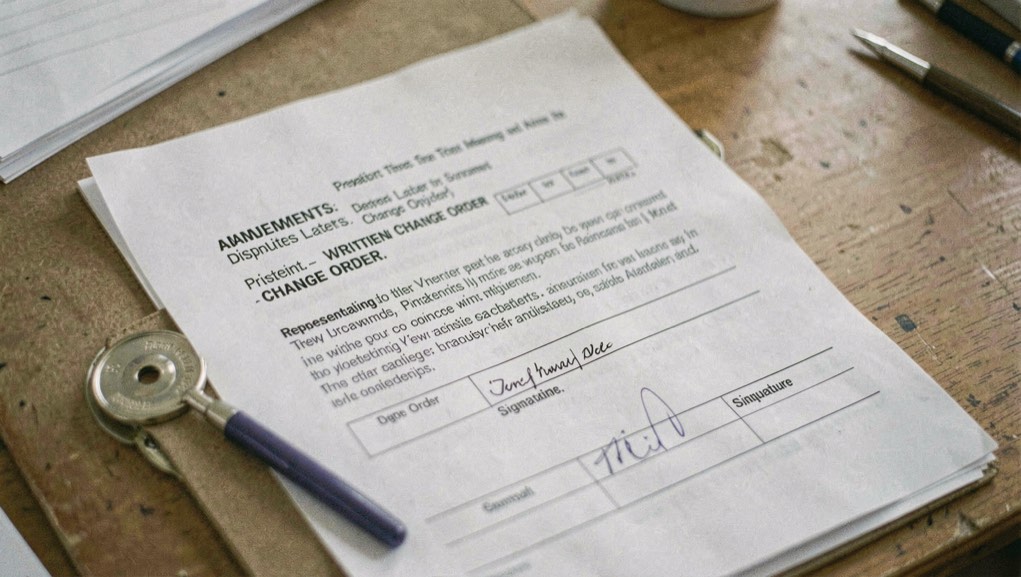
Treat a change as a new record
Projects change because a deliverable is clarified, a date moves, a material becomes unavailable or the people doing the work discover a different constraint. The risky moment is not the change itself. It is the gap between what the team thinks changed and what the contract still says. A written amendment closes that gap by identifying the old agreement, describing the new term and stating when the change takes effect.
Start with a heading such as "Amendment 01" and identify the original contract by its title, date and parties. Give the change its own effective date. If the amendment is signed after work has already changed, say whether it records a prior understanding or applies only from the signature date. That simple distinction prevents a later reader from assuming that every new term applied from the beginning.
Describe the before and after
Avoid a sentence that says only "the parties agree to revise the scope." A useful amendment names the section or attachment being changed and sets out the replacement wording, added deliverable, deleted item or new deadline. Include quantities, file formats, locations, approval steps and dependencies when they affect the result. If a table or schedule changes, attach the complete replacement rather than asking someone to combine fragments by memory.
Use the same defined terms as the original agreement unless the amendment intentionally changes them. A new word can accidentally alter several clauses. Check every cross-reference after the edit and list attachments in the signature version. The Federal Trade Commission's consumer guidance on written contracts offers a practical baseline: make sure the paperwork captures the promises made and keep a copy of the completed document.
Make money and responsibility visible
A scope change often carries a price change, but not always. State the revised total, the incremental fee, the currency, the invoice date and the payment condition. If a credit or refund is due, write how it will be applied. Do the same for schedule effects: name the new milestone, the party responsible for the dependency and what happens if an approval or supplied material is late.
Then revisit responsibility clauses. Does the change affect ownership of work product, confidentiality, data handling, insurance, warranty, service levels or liability? A small change in a deliverable can change the evidence needed to accept it. A short impact paragraph is more useful than a general statement that all other terms remain unchanged, because it tells the reader which neighboring provisions were checked.
Use the signature block as a control
An amendment is a record only when the people authorized to bind the parties approve it in the required way. Reuse the original parties' legal names and check whether the contract permits electronic signatures, counterparts or a particular notice method. Include printed names, titles where relevant, signatures and dates. If one side signs first, keep the fully executed copy with the original contract and the prior amendments.
A signature does not repair an unclear description. Before sending the amendment, ask a person who was not involved in the negotiation to read it against the original and explain what changed. If that reader cannot identify the new price, deadline, scope and responsibility in a few minutes, the document is not yet doing its job.
Keep a clean project history
Name files consistently, preserve the signed version and record which amendment is current. The working folder should make it possible to answer four questions: what was agreed at the start, what changed, when did it change and which version governs today? Do not silently replace the original contract, because the history may matter if a payment, delivery or notice is later disputed.
The Uniform Law Commission notes that the UCC is state law, not federal law, and that state enactments can vary. This article therefore describes record-keeping, not the legal sufficiency of a particular modification. When the amendment affects a high-value project, a regulated activity or a disputed right, obtain advice in the relevant jurisdiction before relying on it.
One recurring case is the edit that draws on archive footage, where the licence is often granted by a rights holder rather than the commissioning party. The amendment should name the clip, the permitted use, the territory and the term, and should say who signs. If the clip is later reused in a different cut, the original permission may not cover it. A short guide on licensing an archive clip sets out the fields to check before the edit is locked. Record the signed version with the project files, as with any other modification.
A parallel case is election law, where state rules govern registration and voting and the steps differ by state. A registering to vote step by step guide for Idaho sets out the sequence, the documents and the deadlines a resident must meet. The same pattern applies to amendments: the state statute controls the record, not the label the parties use. Read the governing state text before you sign, and keep the written record the statute expects. Where the amendment touches a regulated activity or a disputed right, obtain advice in the relevant jurisdiction.