Founder agreements that define ownership early
Questions to settle early about equity split, vesting schedule, decision rules and records between founders.
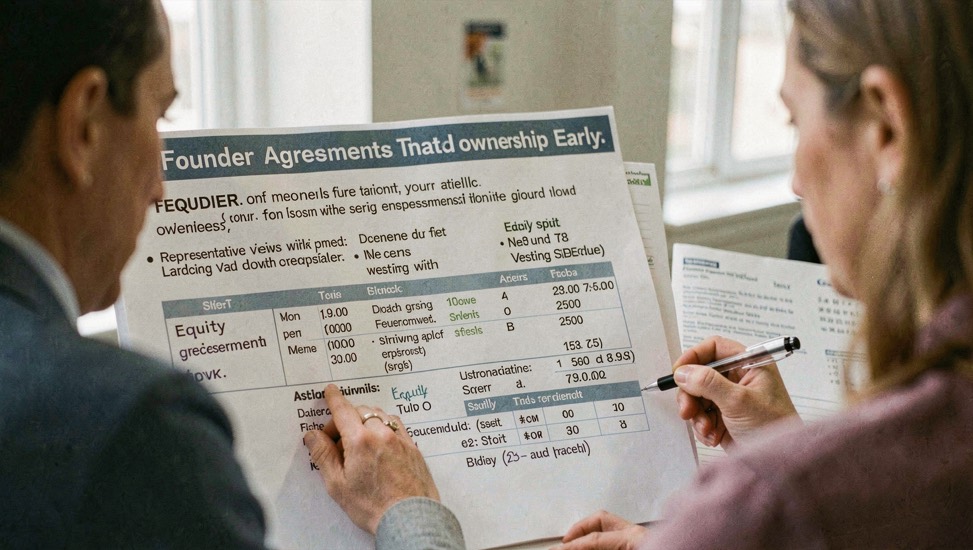
Put the relationship on paper early
Founders often begin with a shared idea, uneven time commitments and an assumption that the details can be settled later. A founder agreement turns those assumptions into questions while the relationship is still easy to discuss. It should identify the people involved, the venture or entity, the work each person expects to contribute and the records that will show what was agreed.
The document does not need to predict every future event. It needs to make the important choices visible: ownership, decision rights, contributions, compensation, intellectual property, confidentiality and an exit path. Use a dated draft, keep earlier versions and connect the agreement to the formation documents. If the entity later adopts an operating agreement, bylaws or shareholder agreement, reconcile the terms instead of leaving two conflicting rulebooks in circulation.
Explain the equity split
Write the ownership percentage or number of units, the class or type of interest and what each person gives in return. Contributions may include cash, equipment, existing code, customer relationships or future work. If a contribution is promised rather than delivered, record the condition and date. Avoid vague language such as "equal ownership" when equal shares, equal votes and equal economics are not intended to be the same thing.
The agreement should also say how new ownership can be issued, whether existing owners receive a chance to participate, and how a sale or transfer is handled. These points are not merely financial. They affect control, dilution and the ability to bring in a new person. Ask the entity's formation state and tax professional how the planned arrangement should be documented before anyone relies on a percentage written in an informal note.
Make vesting and departure understandable
If ownership is earned through continued work, describe the schedule in plain language: the starting date, the earning intervals, the treatment of a departure and the decision-maker who calculates the unearned portion. Use examples that show what happens if a person leaves voluntarily, is removed for cause, dies or becomes unable to continue. The point is not to choose a universal formula. It is to avoid discovering that the founders used different meanings for "earned" and "owned."
A departure section should address company property, confidential information, access credentials, customer communications, unfinished work and the process for valuing or transferring an interest. It should distinguish a business decision from a personal accusation. Clear triggers and written notices make a difficult transition more manageable, but the enforceability of a restriction depends on local law and the wording used.
Set decision rules before the first conflict
List decisions that can be made by one founder, a majority, a specified threshold or unanimous consent. Include hiring, borrowing, large contracts, pricing changes, ownership issues, related-party transactions and a sale of the business. Name who can sign for the company and where approvals are recorded. A small approval matrix can prevent a silent assumption that everyone has the same authority.
Add a deadlock process. It might be a structured meeting, a neutral mediator, a cooling-off period or a buyout discussion. The process should state what happens to ordinary operations while the disagreement is open. The SBA describes operating agreements as records of how key financial and functional decisions are made. A founder agreement should fit that same discipline and be reflected in the entity's formal records.
Reconcile ownership with work and rights
Make a list of assets created before and after formation. Decide how code, designs, documents, inventions, domains and customer materials are licensed or assigned, and state what happens to third-party materials. Do not assume that paying for a file automatically settles intellectual-property ownership. Check employment, contractor and confidentiality terms as separate documents where needed.
Review the agreement after a major funding event, new founder, change in role or material shift in time commitment. Keep a signed copy and a short decision log. This guide is general educational information for readers in the United States. It does not create a partnership, employment relationship or attorney-client relationship, and it cannot determine the right terms for a specific venture.
Ownership terms also depend on who performs the ongoing work. A separate guide on community development finance examines how tasks are assigned, who holds decision rights and how contributions are recorded when a group builds something together. Founders can apply the same discipline: name the people doing the work, write down what each one contributes, and note how that contribution affects equity or control. The two questions overlap, because a founder who stops contributing raises the same issue as a community project without a clear owner. Readers can review the guide alongside their own agreement.
Ownership terms sit in one legal system, but trading conditions often sit in another. A founder registered in Scotland who sells into the United States can face two sets of rules at once, and the Scottish side has its own support schemes. Rates relief for a small firm, for example, is administered through local councils rather than a single national body, so eligibility and deadlines vary by area. The guide at rates relief for a small firm sets out how grants and rates relief work in Scotland and what a small business needs to check before applying.
Ownership terms are easier to defend when the underlying idea has been tested first. A short validation step, such as interviewing potential customers or running a small paid pilot, produces evidence that can shape equity splits, vesting schedules and role definitions before anyone signs. Legal Kits describes this step in its page on testing a business idea before you launch, which covers ways to check demand and cost assumptions early. Founders who validate first often negotiate clearer terms, because the discussion moves from opinion to documented results. The same discipline applies when choosing a structure, whether a sole trader or limited company fits the venture.